
REMA: Efficient Online Robotic Reinforcement Learning
with Explicit Manifold Alignment
A plug-in manifold-based credit assignment framework that improves sparse-reward robotic RL by preserving informative failures and suppressing uninformative divergent rollouts.
1 School of Electrical and Electronic Engineering, Nanyang Technological University, Singapore
2 Shenzhen International Graduate School, Tsinghua University, China
3 Institute for Infocomm Research, A*STAR, Singapore
† Corresponding author
Abstract
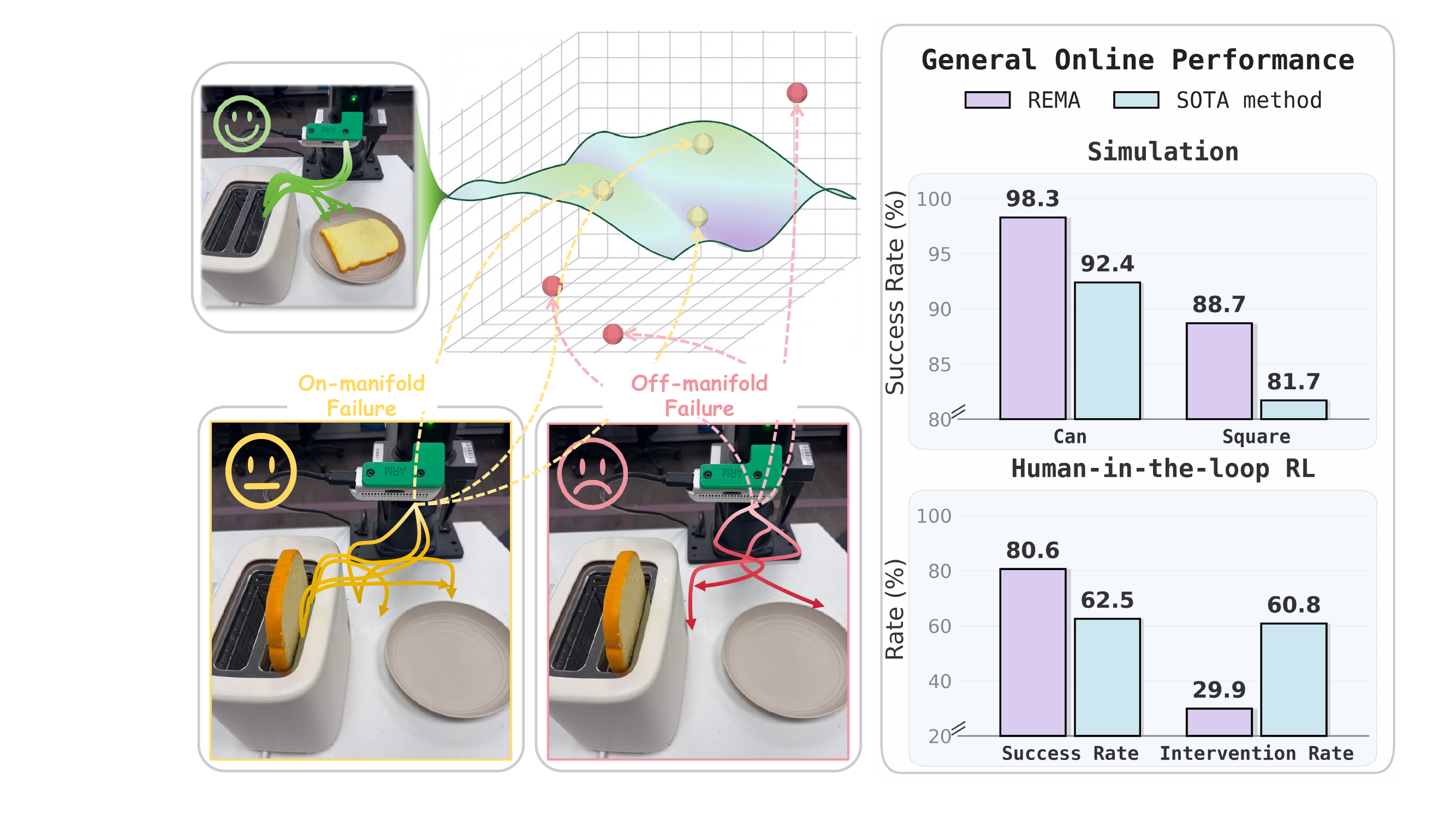
Online reinforcement learning enables robots to improve through real-world interaction, but contact-rich manipulation remains difficult under sparse binary rewards. Conventional reward shaping often depends on goal-proximity heuristics and does not explicitly distinguish informative near-success failures from uninformative divergent trials. REMA addresses this credit assignment problem by aligning online trajectories with a spectral reference manifold constructed from successful demonstrations. Low-frequency DCT components capture task-relevant motion structure, allowing REMA to identify whether a failed trajectory is informative or off-manifold. Distant failures receive calibrated penalties that suppress noisy value-learning signals, while aligned near-misses remain useful for policy improvement. Across RoboMimic simulation tasks and real-world human-in-the-loop manipulation on Galaxea-A1 and Franka Research 3, REMA improves sample efficiency, reduces human intervention, and increases autonomous success.
Sparse rewards make all failures look equally bad
In contact-rich manipulation, binary rewards are easy to define but poor at assigning credit. A robot that almost grasps the target object and a robot that wanders in free space both receive zero reward. The first trajectory contains useful geometric information about the task, while the second mainly injects noise into value learning. REMA starts from this distinction: the quality of a failed trajectory should be judged relative to successful behavior, not only by its final reward.
Follows task-relevant geometry; useful for value learning.
Leaves the successful-behavior manifold; should be suppressed.
Explicit manifold alignment for discriminative credit assignment
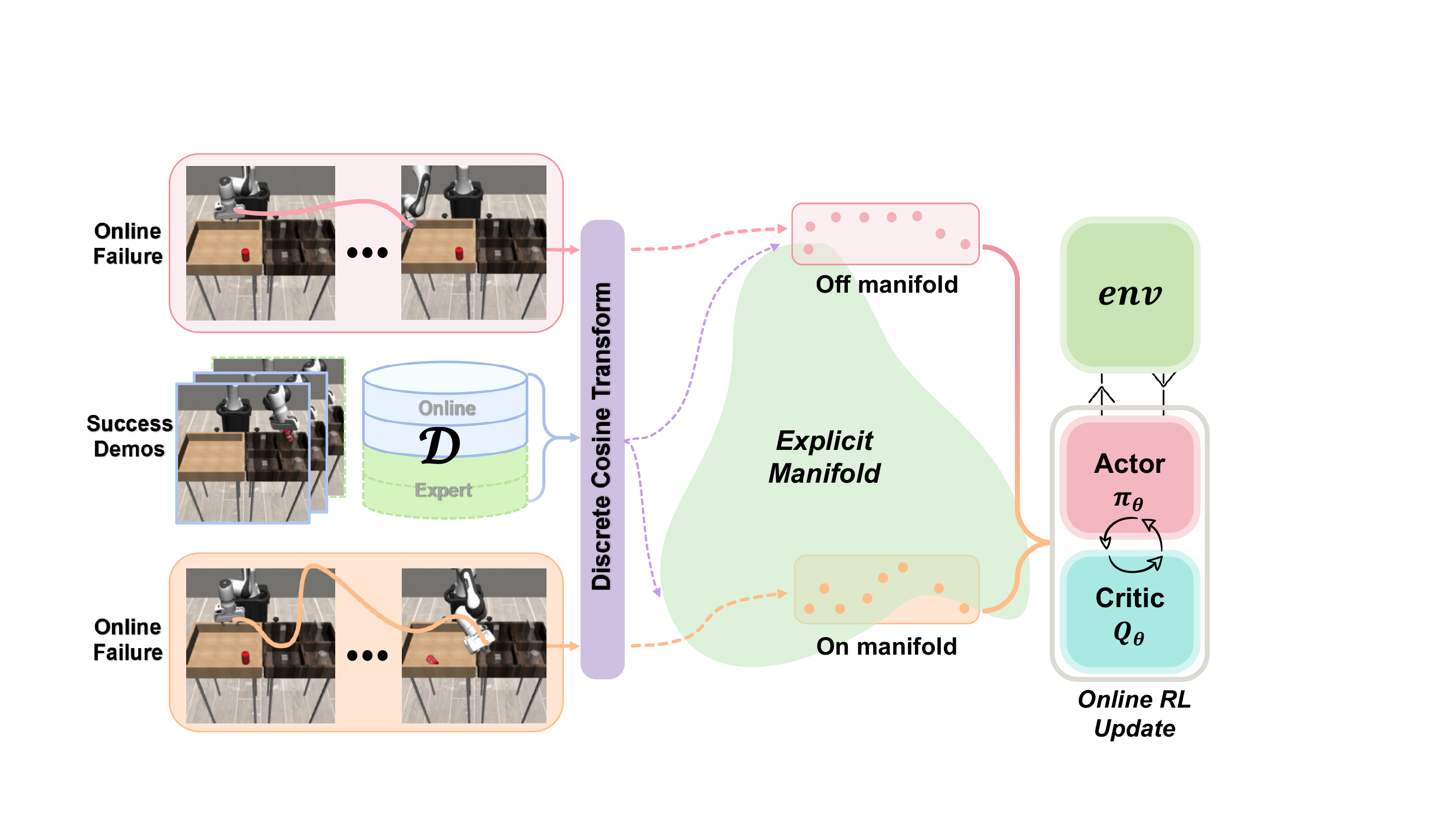
The core mechanism is deliberately simple. Successful trajectories define a reference manifold in end-effector task space. Each online trajectory is aligned and compressed into a spectral representation. Its normalized distance to the reference manifold determines whether the trajectory should be preserved as informative experience or penalized as an off-manifold deviation.
Build a reference manifold
REMA starts from a small set of successful demonstrations. Each trajectory is represented in end-effector task space, including position, rotation, and gripper state. The successful trajectories define the reference behavior structure for the task.
Compress motion structure spectrally
After geometric alignment, REMA applies the Discrete Cosine Transform to extract low-frequency motion components. These components summarize global task-relevant motion while filtering high-frequency execution noise.
Calibrate online trajectories
During online learning, each failed trajectory is compared with the reference manifold using normalized spectral distance. Off-manifold failures are penalized to reduce their impact on value estimation, while aligned failures are preserved as informative experience.
Why REMA is plug-in
No auxiliary networks. No new policy architecture. No change to the underlying RL algorithm.
REMA acts after rollouts are collected. It calibrates the reward signal used for value learning, making it compatible with standard value-based online RL and human-in-the-loop RL pipelines.
More stable online learning with less human effort
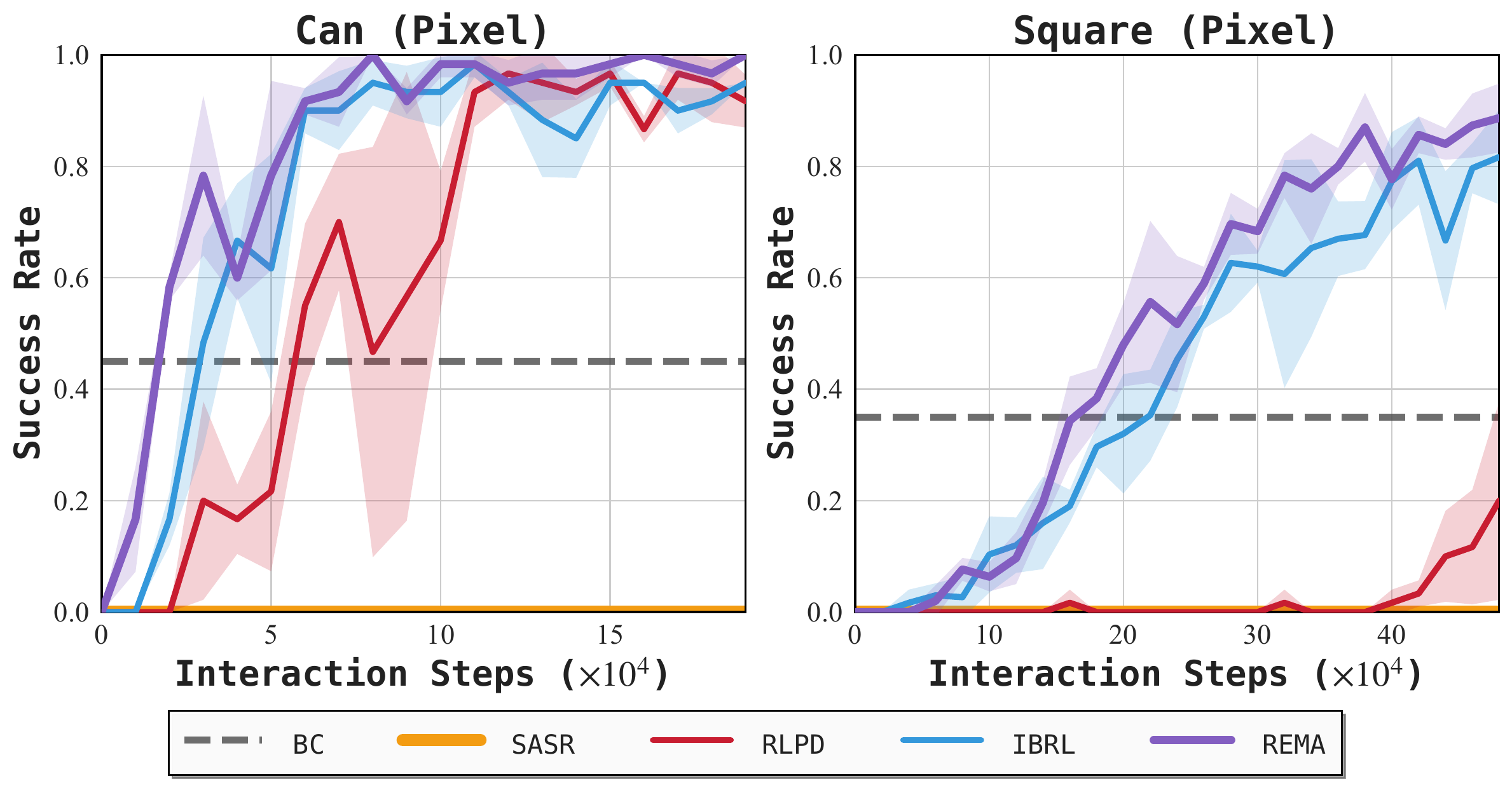
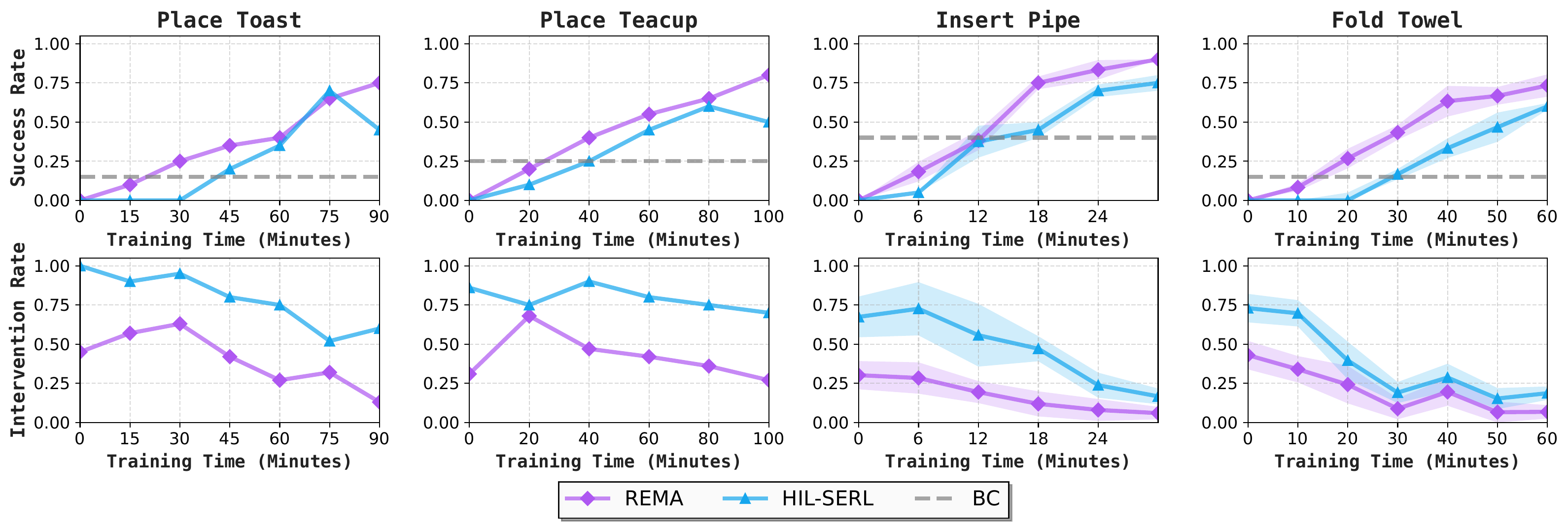
Across RoboMimic Can and Square, REMA improves learning speed and final success compared with standard imitation and value-based RL baselines. On real robots, REMA reduces human intervention from 60.8% to 29.9% and improves autonomous success from 62.5% to 80.6% in human-in-the-loop RL, while using the same intervention equipment and offline data as the compared setup.
Simulation results
In simulation, REMA is evaluated on RoboMimic Can and Square. The experiments compare against behavior cloning, IBRL, RLPD, and SASR under matched seeds and hyperparameters. REMA improves early-stage learning and final convergence, showing stronger sample efficiency and lower variance across runs.
Real-world human-in-the-loop training
In real-world human-in-the-loop RL, REMA is evaluated on Galaxea-A1 and Franka Research 3 across four tasks covering precision, contact sensitivity, distractors, and deformable-object manipulation. Both platforms use side-fixed and wrist-mounted cameras, and human interventions are provided using a 6D SpaceMouse. REMA uses the same offline data and intervention equipment as the compared HIL-SERL setup, differing only by applying manifold-based reward calibration to collected trajectories.
Place Toast
Pick toast from the toaster and place it on a plate. Galaxea-A1
Place Teacup
Grasp a target teacup among distractors and place it on a plate. Galaxea-A1
Insert Pipe
Perform tight-tolerance contact insertion. Franka Research 3
Fold Towel
Manipulate a deformable towel. Franka Research 3
Offline-to-online fine-tuning
Beyond learning from scratch, REMA also calibrates offline-to-online fine-tuning. Under a matched 30-minute online budget, REMA consistently improves over WSRL across the evaluated real-world tasks, with especially clear gains on the deformable Fold Towel task.
| Task | Pretrained (Cal-QL) | WSRL @ 30 min | REMA @ 30 min |
|---|---|---|---|
| Place Teacup | 9/20 | 13/20 | 16/20 |
| Insert Pipe | 11/20 | 17(±2)/20 | 19(±1)/20 |
| Fold Towel | 6/20 | 11(±3)/20 | 14(±2)/20 |
Place Teacup on Galaxea-A1 is a single online fine-tuning run; Insert Pipe and Fold Towel on Franka Research 3 report mean ± std over three independent runs, each evaluated with 20 autonomous trials.
Videos
REMA overview video
Method summary and real-world human-in-the-loop training results — coming soon
Place Toast on Galaxea-A1
Task video coming soon
Place Teacup with distractors on Galaxea-A1
Task video coming soon
Insert Pipe on Franka Research 3
Task video coming soon
Fold Towel on Franka Research 3
Task video coming soon
Understanding the calibration behavior
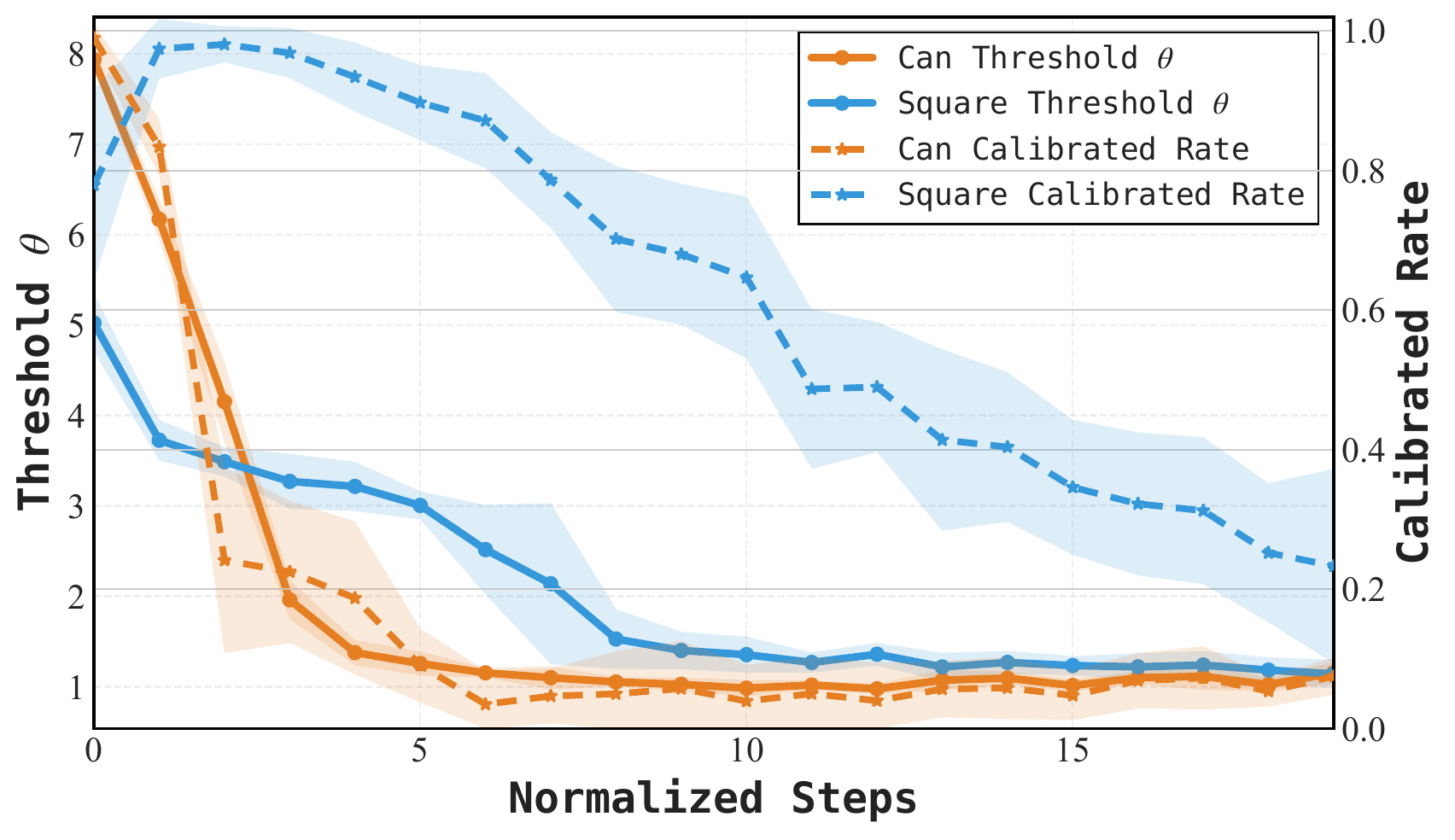
Calibration dynamics
As online training progresses, the manifold threshold adapts with successful experience and the calibration rate declines. This shows that REMA is self-regulating: it strongly suppresses random early exploration, then relaxes as the policy becomes aligned with the successful-behavior manifold.
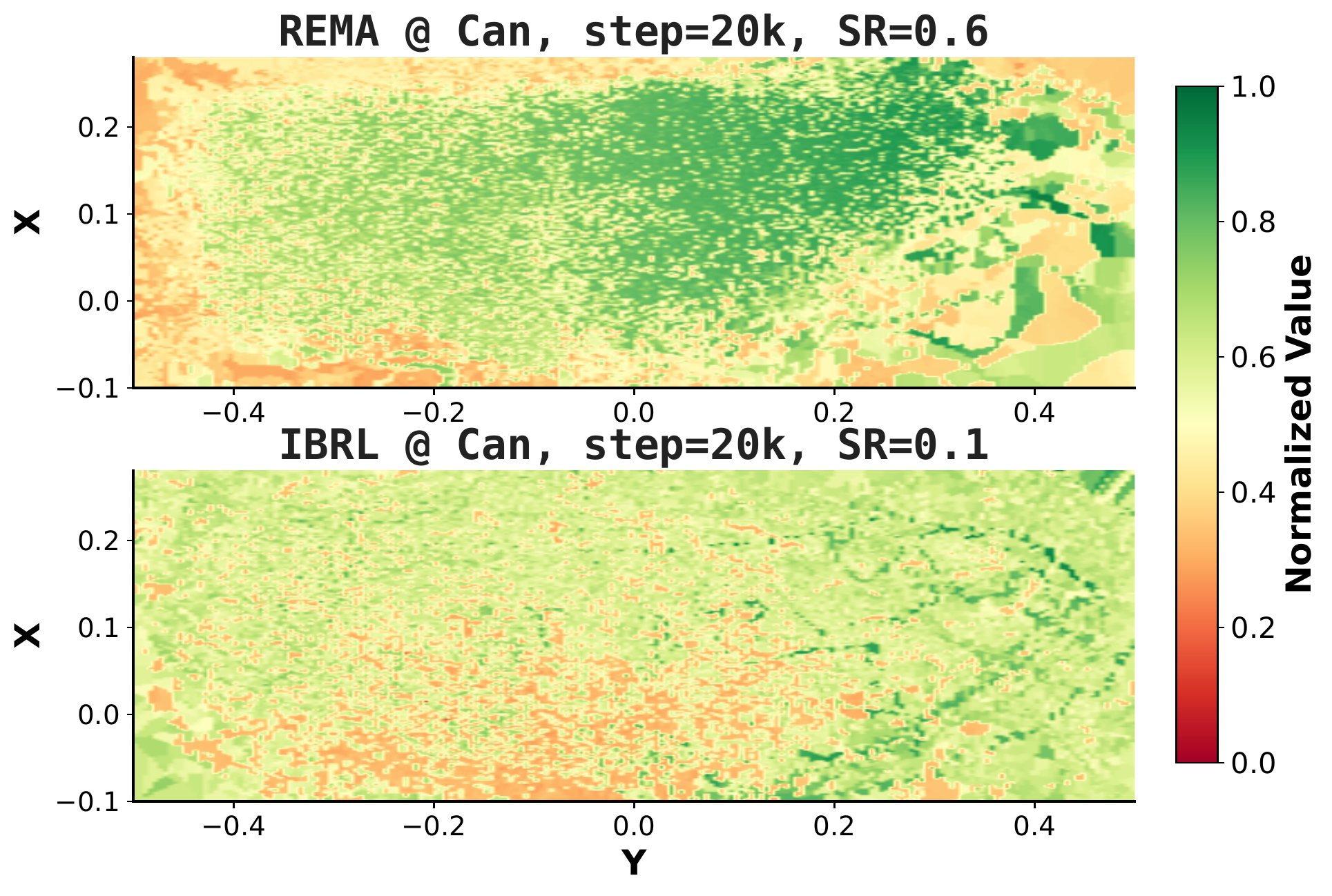
Value landscape
REMA produces sharper value boundaries over task-relevant regions, whereas the baseline value landscape is more diffuse. This suggests that manifold-calibrated penalties help value learning become more sensitive to geometric task structure.
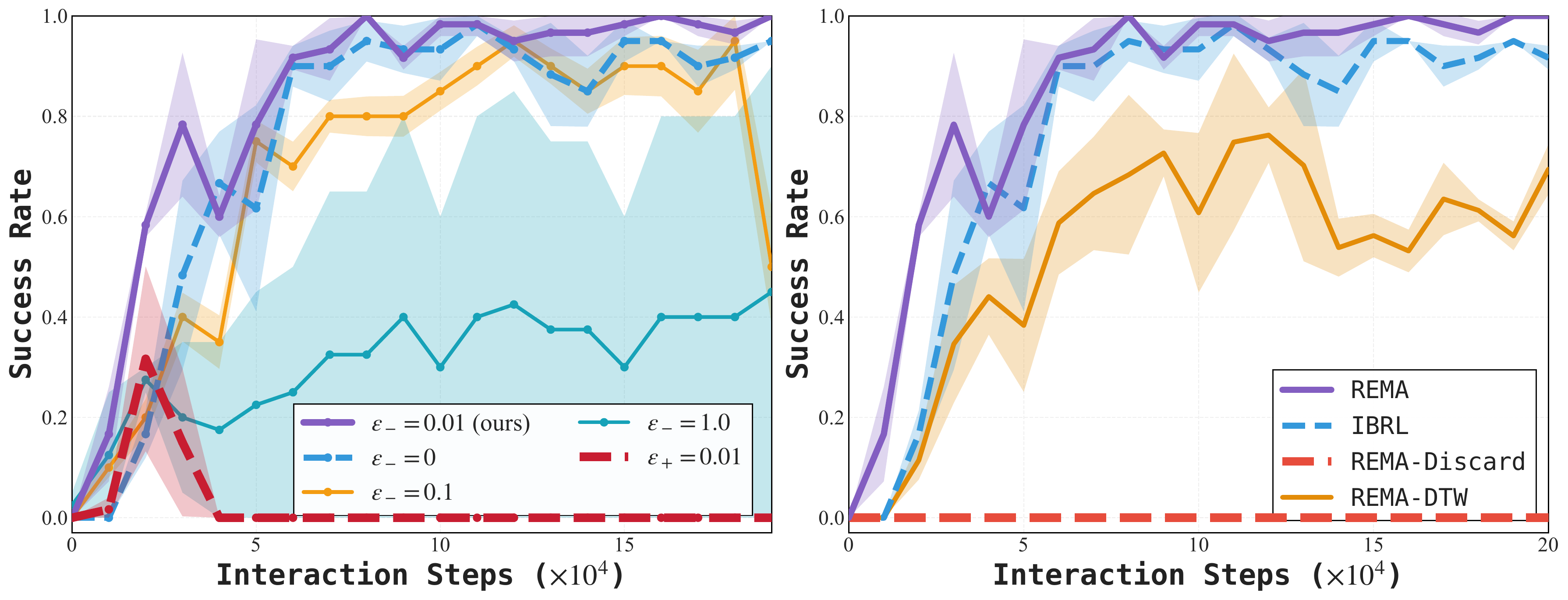
Robustness and boundary cases
Ablation
Ablations show that a small penalty magnitude is important for preserving the optimal policy while suppressing uninformative failures. DCT-based spectral distance performs better than temporal alignment with DTW in the evaluated setting.
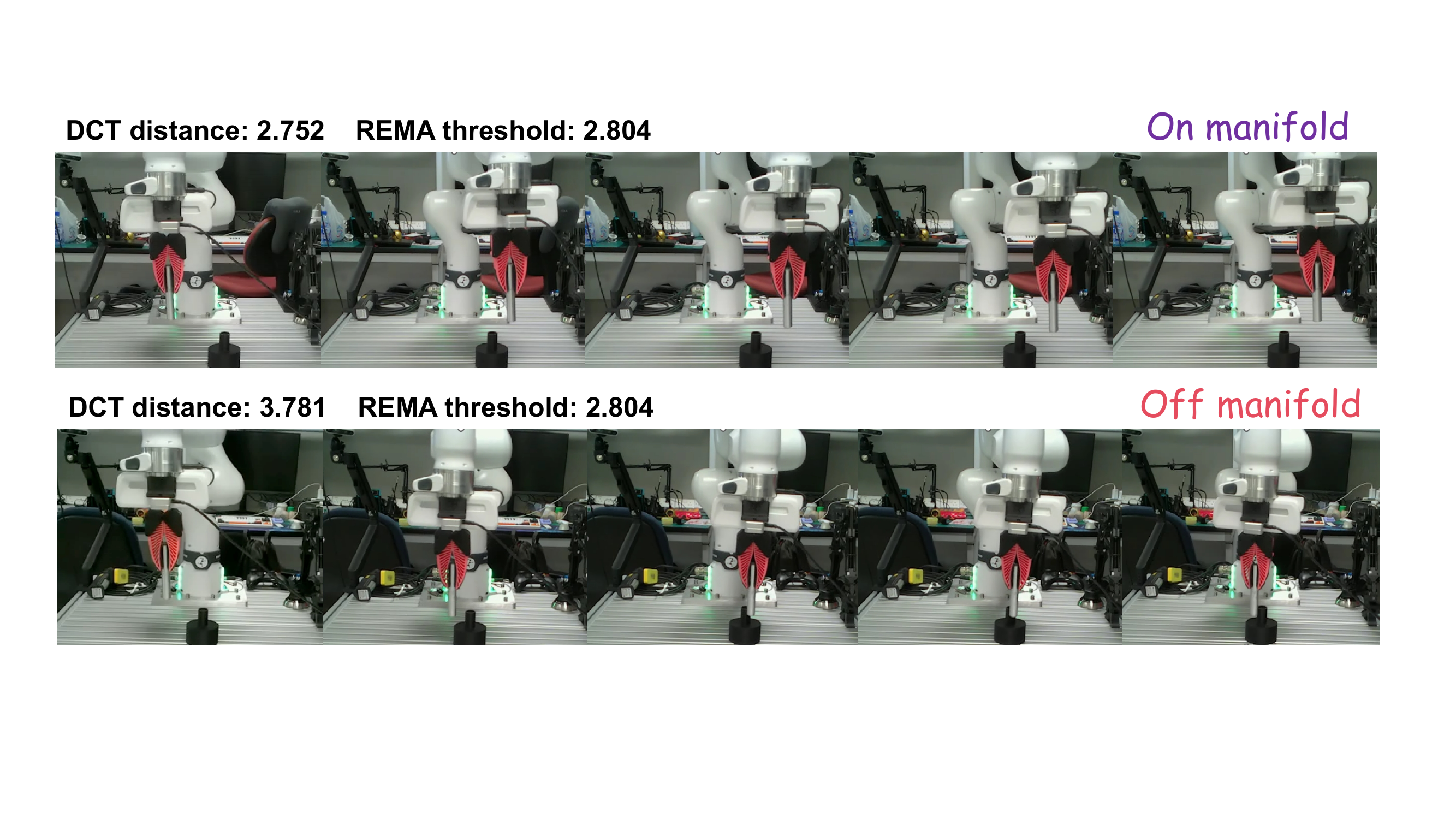
Failure mode
The spectral distance captures global motion shape, which makes it robust to execution-speed variability. However, it can underweight spatial outcome differences or localized contact irregularities. This motivates future extensions with multi-resolution or learned manifolds.
Limitations
REMA captures global motion structure through low-frequency spectral features. This makes it robust to execution-speed variation but less sensitive to localized contact irregularities or qualitatively different success modes. Future extensions may use multi-resolution features, clustered manifolds, or learned trajectory representations when longer online-adaptation budgets justify additional representation learning.
Citation
@article{guo2026rema,
  title={Efficient Online Robotic Reinforcement Learning with Explicit Manifold Alignment},
  author={Guo, Wenkai and Tang, Peizhi and Bai, Yukun and Yan, Ziming and Deng, Haoyuan and Lu, Guanxing and Li, Shijie and Wang, Ziwei},
  journal={IEEE Robotics and Automation Letters},
  year={2026},
  url={https://ieeexplore.ieee.org/abstract/document/11668937}
}